ESCO Success Story
ESCO Turbine Technologies | Success case stories
ESCO Turbine Technologies (formerly a division of ESCO Corporation) was a manufacturer of precision investment-cast components for the aerospace, energy, and industrial markets. Specializing in complex superalloy castings, they produced crucial turbine parts before being acquired by Consolidated Precision Products (CPP).
The ESCO Turbine Technologies (Syracuse, NY) case study is a prominent example of how Training Within Industry (TWI)—specifically the Job Instruction (JI) module—can be used to solve critical production and quality issues in high-precision manufacturing.
Core Problem: The “Nozzle” Issue
The facility, which specializes in investment casting for aerospace and power generation turbines, faced a significant quality crisis involving a specific turbine nozzle part.
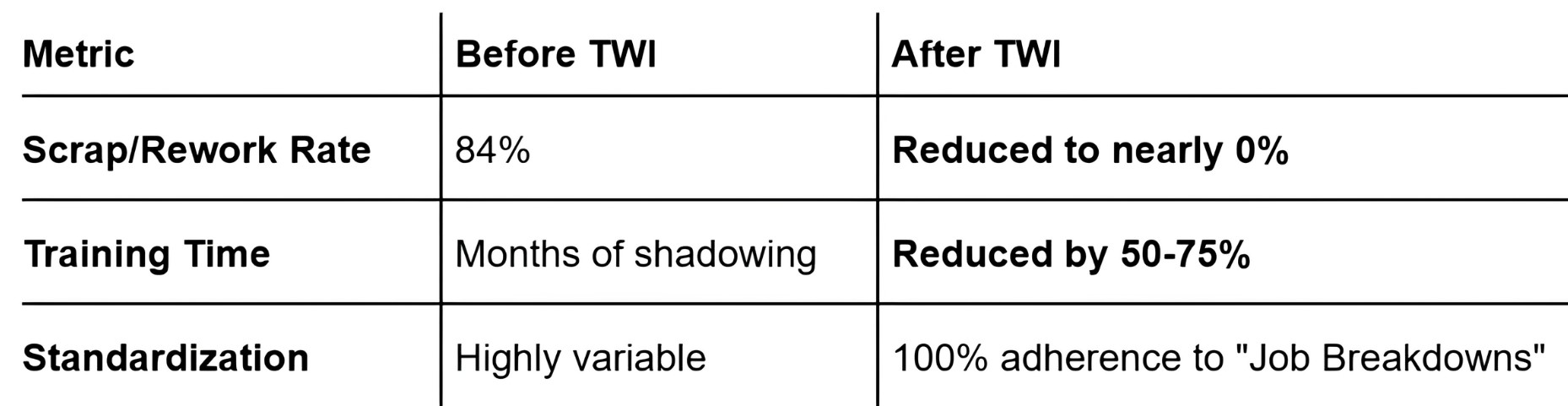
- High Defect Rate: One particular part had a staggering 84% scrap/rework rate, meaning only 16% of parts were made correctly on the first attempt.
- Skill Gaps: Experienced operators were retiring, and the training of new staff was inconsistent, leading to “tribal knowledge” where everyone performed the job differently.
TWI Implementation & Results
Using the JI (Job Instruction) method, the company standardized the “best way” to perform the complex casting and finishing tasks.
Key Takeaways from the Study
- Job Instruction Breakdowns: Supervisors identified “Key Points”—the small “knacks” or safety tricks that make or break a task—and incorporated them into formal training.
- Supervisor as Trainer: Instead of HR or outside consultants, the shop floor supervisors became the primary teachers, ensuring the training was practical and respected.
- Foundation for Lean: This success helped ESCO establish a foundation for more advanced Lean manufacturing techniques by first stabilizing their processes.
Note: In late 2012, ESCO Corp. sold its Turbine Technologies division (which included the Syracuse and Concorde Castings facilities) to the newly formed Consolidated Precision Products (CPP). But the case study remains a staple in TWI Institute curricula for showing how the 1940s-era TWI program still works in modern high-tech environments
Other News